
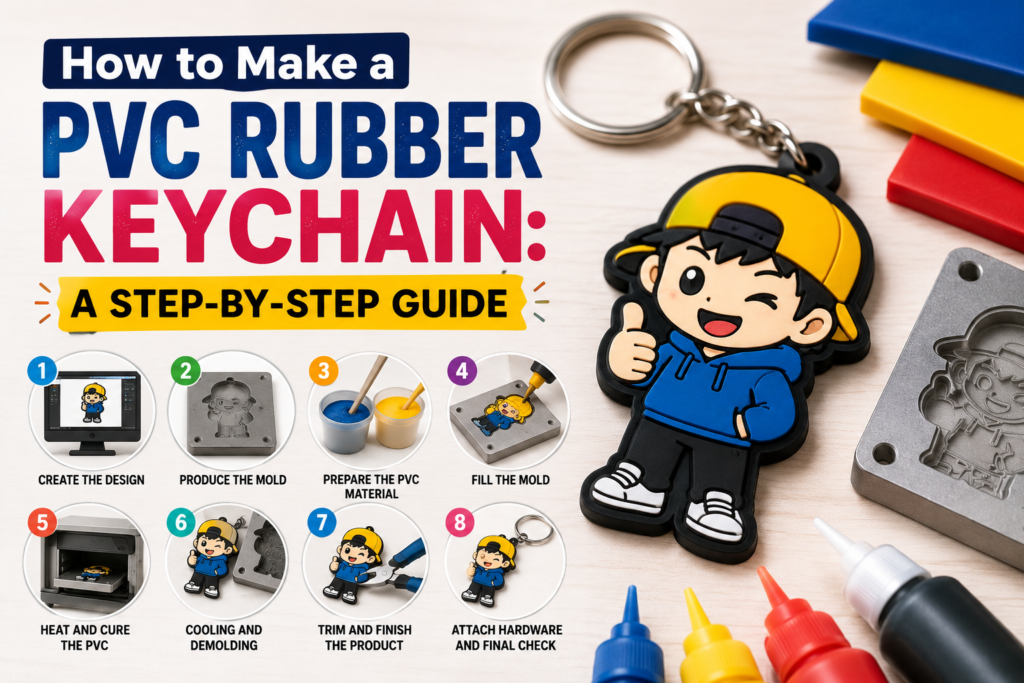
PVC rubber keychains have become one of the most popular promotional and souvenir products in the world. Businesses use them for branding, artists sell them as merchandise, and organizations hand them out at events. Their popularity comes from three simple qualities: they are durable, colorful, and highly customizable.
If you’ve ever wondered how to make a PVC rubber keychain, this guide explains the complete manufacturing process in a clear and practical way. Whether you’re planning to produce custom keychains for your business or simply want to understand how they’re made, you’ll find everything you need here.
What Is a PVC Rubber Keychain?
A PVC rubber keychain is a flexible keychain made from soft Polyvinyl Chloride (PVC). Unlike metal or acrylic keychains, PVC keychains have a soft-touch feel and can feature detailed 2D or 3D designs.
Manufacturers often use soft PVC because it offers:
- Excellent durability
- Water resistance
- Vibrant colors
- Flexible design options
- Long-lasting performance
These qualities make PVC keychains ideal for promotional products, souvenirs, brand merchandise, and custom gifts.
Materials Needed to Make PVC Rubber Keychains
Before production begins, manufacturers prepare several materials and components:
- Soft PVC compound
- Color pigments or color paste
- Metal split rings
- Jump rings or chains
- Custom metal mold
- Heating oven or curing equipment
- Dispensing or injection equipment
The mold plays a crucial role because it determines the shape, size, and details of the final keychain.
Step 1: Create the Keychain Design
Every PVC rubber keychain starts with a design.
Designers typically use software such as Adobe Illustrator or CorelDRAW to create digital artwork. The design should clearly show:
- Shape and dimensions
- Color areas
- Raised and recessed sections
- Text placement
- Logo details
Simple designs usually work best. Extremely tiny details may not reproduce well in soft PVC.
Think of the mold as a cookie cutter. If the artwork looks clean and organized, the final product usually looks better too.
Step 2: Produce the Mold
After approving the artwork, manufacturers create a custom mold.
Most molds are made from aluminum or steel using CNC machining. The mold contains engraved cavities that match the design.
This stage often represents the largest upfront cost because every unique design requires its own mold.
The good news? Once the mold exists, manufacturers can produce thousands of identical keychains with consistent quality.
Step 3: Prepare the PVC Material
Next, technicians prepare the PVC compound.
They mix soft PVC with pigments to achieve the required colors. Proper color matching is important, especially for brand logos and promotional products.
Manufacturers often follow standardized color systems to maintain consistency across production batches.
The mixture must remain smooth and free of trapped air. Some factories use vacuum systems to remove air bubbles before production.
Step 4: Fill the Mold
This is where the design starts to come alive.
Using dispensing machines or injection systems, operators carefully fill each section of the mold with colored PVC material.
For multi-color designs, they apply colors one section at a time.
Imagine coloring inside a coloring book—but with liquid PVC instead of crayons.
For 3D PVC keychains, manufacturers build multiple layers to create depth and texture. Raised areas require additional material and production steps.
Accuracy matters during this stage because color bleeding can affect the final appearance.
Step 5: Heat and Cure the PVC
After filling the mold, the keychains move into a curing oven.
Heat causes the PVC material to solidify and take its final shape. The temperature and curing time depend on:
- Product size
- Thickness
- Number of layers
- Design complexity
Once curing finishes, the material becomes flexible yet durable.
This step transforms liquid PVC into the soft rubber-like product people recognize as a PVC keychain.
Step 6: Cooling and Demolding
After curing, the molds cool down.
Operators then remove the finished keychains from the mold cavities.
At this stage, manufacturers inspect the products for:
- Surface defects
- Color accuracy
- Shape consistency
- Material imperfections
Quality control helps ensure that every keychain meets production standards.
Step 7: Trim and Finish the Product
Small amounts of excess material can appear around the edges after molding.
Manufacturers trim these edges carefully to create a clean finish.
Depending on the design, additional finishing may include:
- Surface cleaning
- Edge refinement
- Layer inspection
- Final polishing
A well-finished PVC keychain should feel smooth and look professional from every angle.
Step 8: Attach Hardware
The final production step involves attaching the hardware components.
Manufacturers add:
- Split rings
- Key rings
- Chains
- Clips or hooks
These accessories transform the PVC design into a functional keychain ready for everyday use.
After assembly, the keychains are packaged and prepared for shipping.
2D vs. 3D PVC Rubber Keychains
When creating a custom PVC rubber keychain, you’ll usually choose between two styles.
2D PVC Keychains
2D designs feature a flat surface with colored sections separated by raised borders.
Advantages include:
- Lower production cost
- Faster manufacturing
- Ideal for logos and simple graphics
3D PVC Keychains
3D keychains contain multiple levels and raised elements.
Advantages include:
- Greater visual impact
- Enhanced detail
- Premium appearance
Businesses often choose 3D designs when they want their merchandise to stand out.
Can You Make PVC Rubber Keychains at Home?
Technically, yes—but not easily.
Professional PVC keychain manufacturing requires specialized equipment, molds, temperature-controlled ovens, and material handling systems.
Most artists and small businesses choose custom manufacturers rather than producing PVC keychains themselves.
For small-scale DIY projects, alternative materials such as resin or 3D printing filament may offer a more practical solution.
Looking for Premium Quality Custom Products?
At Premium Quality Patches, we don’t just create PVC rubber keychains—we bring your brand ideas to life with precision and premium craftsmanship.
Whether you need custom PVC keychains, embroidered patches, PVC patches, chenille patches, leather patches, woven patches, or promotional products, we provide everything under one roof with consistent quality and fast turnaround.
From small creative batches to large bulk production, our team ensures every detail matches your vision perfectly.
Why Choose Us?
- High-quality in-house production
- Durable, waterproof, and long-lasting materials
- Free design support & unlimited revisions
- Bulk orders with competitive pricing
- Worldwide shipping with reliable delivery
Final Thoughts
Learning how to make a PVC rubber keychain helps you appreciate the craftsmanship behind these small but effective products.
The process involves designing artwork, creating a custom mold, preparing colored PVC, curing the material, and assembling the finished keychain. While the production workflow requires specialized equipment, the result is a durable and highly customizable product that works well for branding, retail merchandise, events, and souvenirs.
A great PVC keychain does more than hold keys. It carries a brand, a memory, or sometimes a favorite character around all day. Not bad for something that usually fits in your pocket.